
Tables are used whenever you have tabular data to display. If it’s something you would put into a spreadsheet, then you’ll want to put it into a table. If you would use a text document instead, then put it in a list or paragraph format.
Creating a Table
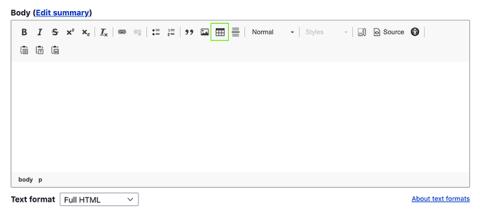
To begin, click on the table icon in the WYSIWYG editor.
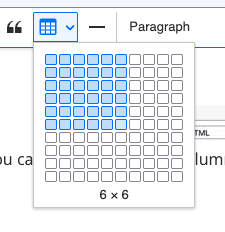
A Table Properties dialogue box will appear. This is where you can select how many columns and rows you want in your table.
To create a table, hover over the number of rows and columns you would like displayed, keeping in mind any headers. Blue squares indicate the table layout and the table's dimensions can be seen at the bottom of the dialogue box. Once you have settled on a dimension, click to create the table.
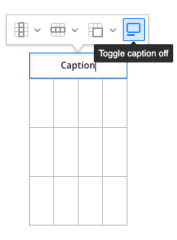
To adjust these values after you have created a table click on any cell to insert new rows, columns, headers, or a caption.
Adding, Deleting Rows & Columns
You may add a row or column either before or after any pre-existing row or column.
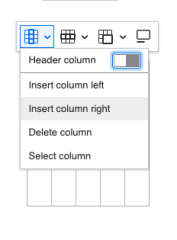
- With your cursor in a cell either before or after the new column, click on the table > Column > and select either Insert Column Left or Insert Column Right. The process for Row is the same.
- You can also delete rows and columns in this manner by placing your cursor on one of the cells within the row or column and right-clicking > click on Column or Row > Delete Column or Delete Row.
Note: You can add new rows to the bottom of the table by simply placing your cursor in the bottom-right cell and pressing tab. This is helpful when making large tables with lots of content to input.
Adjusting Cell Properties
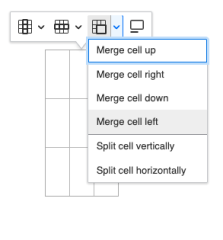
- If you need to adjust the properties of an individual cell place your cursor on the cell, click on the arrow next to the Cell icon, then select the desired action from the drop-down menu, such as merging or splitting cells.
- Doing this will only merge a single cell, thus if wanting to merge several cells within multiple rows, you will need to repeat this step.
Important Notes
- For mobile considerations, keep the content in each column brief and concise. Don’t use an excessive amount of columns.
- Don’t include long URL links in table cells. If you are required to use links in cells, link a phrase (i.e. Download) or use a shorter version of the URL (ie www.website.com instead of http://www.website.com).
- The use of merging, inserting, or splitting cells can become a complicated process. If you need to add more data to your table, use the insert row or column, much like a spreadsheet.
- Tables will automatically apply the necessary borders and background colours. It is recommended not to add your own colours in order to keep a consistent look throughout the website.
- Only use tables for tabular data, not to format a document or for critical information, as certain table designs are difficult for screen readers to navigate.